French Press for Two Cups: Coffee and Water
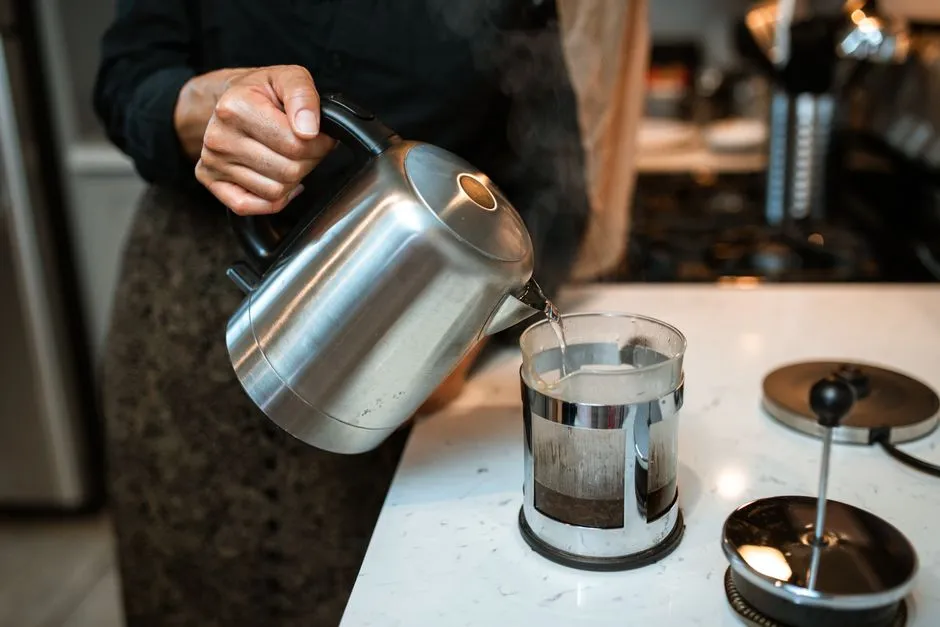
- How much coffee and water do you need for two cups?
- What does “two cups” mean on a French press?
- What is a practical two-mug French press chart?
- Can you make two servings in a larger press?
- How do you brew a small batch without losing the ratio?
- How do you scale the recipe for unequal mugs?
- Why did the two-cup batch come out weak or strong?
- Sources
How much coffee and water do you need for two cups?
For two 240-gram servings, start with 480 grams of water and 32 grams of coffee, a 1:15 coffee-to-water ratio. If your mugs hold 300 grams each, use 600 grams of water and 40 grams of coffee. Measure the mugs you actually use because a French press “cup,” a US measuring cup and a breakfast mug are not the same size.
Those figures describe water added, not the exact drink left after brewing. Grounds hold some water, so the finished yield will be smaller. If filling both mugs to a precise line matters, record the first batch's yield and scale the next batch from what actually reached the cups.
What does “two cups” mean on a French press?
Start by ignoring the word cup and finding a volume.
A manufacturer may use a small coffee-cup convention rather than a US measuring cup. For example, Bodum UK's brew guide lists its Kenya “4 Cup” press at 500 millilitres. That naming works out to 125 millilitres per labelled cup, so two labelled cups would be 250 millilitres, not two full mugs.
NIST separately lists a US cupful as 237 millilitres in its metric household guidance. In other words, a maker's “two cups” may be close to one US measuring cup and still be far short of two mugs.
The reliable method is simple: put an empty mug on a scale, tare it, fill it with water to your normal serving line, and note the grams. Repeat for the second mug if the sizes differ. Add the two measurements to get your batch-water target.
What is a practical two-mug French press chart?
The chart below uses Moav Coffee's editorial 1:15 starting ratio. Divide the planned water weight by 15 to find the coffee dose.
| Planned serving | Water to add | Coffee at 1:15 |
|---|---|---|
| Two 240-gram mugs | 480 g | 32 g |
| Two 300-gram mugs | 600 g | 40 g |
| Two 350-gram mugs | 700 g | 46.7 g, rounded to 47 g |
These are starting measurements, not a claim that one ratio suits every coffee. Fellow's official French press method uses 60 grams of coffee with 840 grams of water, a 1:14 ratio, and a four-minute brew. The difference is useful context: a recipe can be internally consistent without being the only correct recipe.
Start at 1:15 for an easy baseline. If the coffee tastes thinner than you want, use slightly more coffee next time while leaving the other variables alone. If it tastes heavier than you want, use slightly less. Our published coffee-to-water ratio guide explains how to make that adjustment without changing everything at once.
Can you make two servings in a larger press?
You can calculate a partial batch with the same ratio: divide the water you plan to add by 15. A larger vessel does not require a weaker dose simply because its maximum capacity is higher.
The physical press still has to work as its maker intends. Check the model's instructions, make sure the filter assembly can travel normally through the brewed coffee, and keep the water below the stated maximum after the grounds are in the vessel. Do not assume the number printed on the carafe is a mug count.
If a very small batch leaves the coffee bed or filter working poorly in your particular press, use a smaller press rather than improvising around its mechanism. The recipe math scales cleanly; the hardware may have a practical minimum that only its instructions or maker can confirm.
How do you brew a small batch without losing the ratio?
Use one repeatable sequence:
- Weigh the water capacity of the two mugs at their usual fill lines.
- Add those weights and divide the result by 15.
- Weigh that amount of coffee and grind it coarse as a starting point.
- Put the press on a dry, stable surface and add the grounds.
- Add the planned water evenly, staying within the press's marked capacity.
- Follow the press maker's instructions for stirring, steeping and plunging. Fellow's cited method plunges at four minutes, making that a practical first test.
- Press steadily and pour the coffee into both mugs rather than leaving the second serving on the grounds.
For the complete sequence, including grind, temperature and pressing, use our published guide to making French press coffee.
How do you scale the recipe for unequal mugs?
Add the two mug weights before doing the ratio calculation. A 250-gram mug plus a 350-gram mug needs 600 grams of water in total. At 1:15, that is 40 grams of coffee.
The formula is:
total water in grams ÷ 15 = coffee in grams
To scale a known good batch instead, preserve the same proportion. If 480 grams of water with 32 grams of coffee tastes right but does not produce enough finished coffee, increase both numbers by the same percentage. Do not add extra water alone after deciding the dose, because that changes the ratio as well as the yield.
Why did the two-cup batch come out weak or strong?
Check measurement before changing technique.
- Weak coffee: confirm that “two cups” was not interpreted as two 4-fluid-ounce press cups while the vessel was filled for two large mugs. Check the dose and water weight, then adjust one variable.
- Strong or heavy coffee: confirm the ratio, then use slightly less coffee or a coarser grind on the next batch. Keep the steep time stable while testing.
- One full mug and one short mug: grounds retain water. Measure the finished yield, then scale both coffee and water together for the next attempt while staying within the press capacity.
- Different results each morning: weigh the coffee and water. Scoops and mug fill lines are convenient but less repeatable than a scale.
A small batch is not a lesser version of a full carafe. Once “two cups” becomes a measured amount, the same ratio and routine produce a batch sized for the people actually drinking it.