Is a Coffee Scale Worth It? Who Needs One
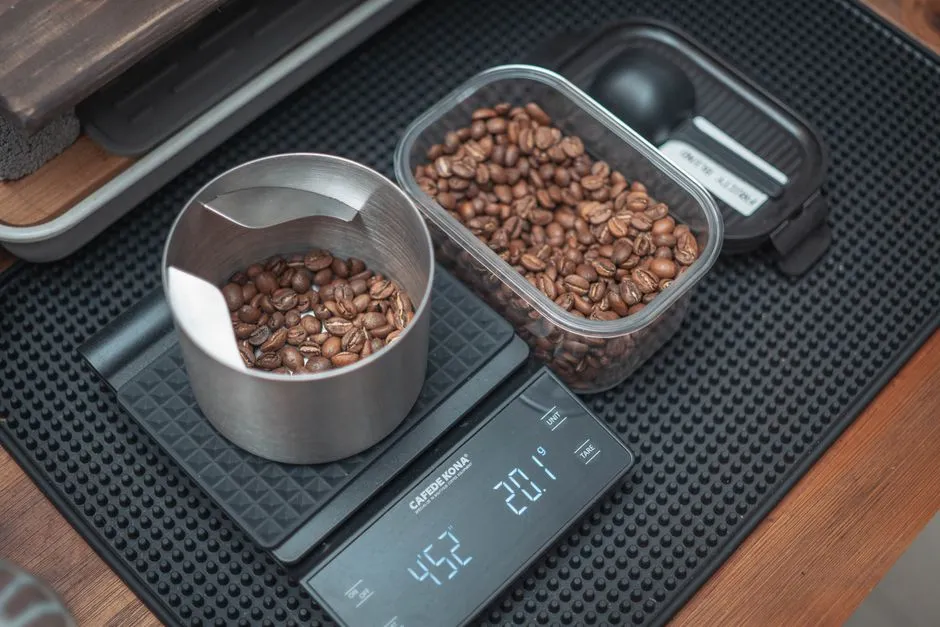
Is a coffee scale worth it?
A coffee scale is worth it when inconsistent doses or pour volumes keep changing your cup. A basic kitchen scale that reads in grams already delivers most of that benefit. Buy a coffee-specific scale only when you also need a built-in timer, faster small changes, a platform that fits your brewer, or finer readings for small doses. It is useful equipment, not a requirement for good coffee.
This guide is desk-researched. We have not tested or ranked individual scales, and there are no affiliate links here. The aim is to help you decide which functions solve a real brewing problem before you pay for them.
What does weighing change?
Weighing replaces two variable measures with repeatable ones: the dry coffee dose and the brewing water. A scoop can hold different amounts as bean size, roast, grind and how the spoon is filled change. A brewer's marked “cup” may also differ from the mug on your desk.
With grams, the calculation stays visible. If you choose a 1:16 coffee-to-water ratio, 20 grams of coffee calls for 320 grams of water because 20 × 16 = 320. If that cup tastes too light, you can change one variable deliberately instead of wondering whether today's scoop was larger.
The ratio is a starting point, not a quality guarantee. Grind, water, contact time, agitation, roast and the coffee itself still affect the result. Our published coffee-to-water ratio guide explains the arithmetic and gives a repeatable adjustment routine.
Can a kitchen scale do the job?
Yes, for many brewers. A kitchen scale is a sensible first test if it:
- displays grams;
- has a tare function, so the brewer can be reset to zero;
- can hold the brewer and expected water weight without exceeding capacity;
- has a platform large enough to sit flat without hiding the display;
- updates quickly enough that you can stop near the intended amount.
A scale that reads in whole grams is usually enough to repeat a typical manual-brew dose. At 1:16, a one-gram coffee difference corresponds to 16 grams of brew water. That may be noticeable in a small cup, but it is far more controlled than an unlevelled or heaped scoop.
Test the scale you already own. Put the empty brewer and server on it, press tare, add the planned coffee, press tare again, then add water. If the display remains readable and responds without frustrating lag, a separate coffee scale may add convenience rather than fundamentally better measurement.
What does a coffee-specific scale add?
Coffee scales commonly combine weight and time on one display. That matters when a recipe asks you to compare both total water and elapsed time while pouring. Some models add automatic timing or taring modes, but those are workflow features rather than requirements.
Current manufacturer specifications show why exact-model verification matters. Hario's V60 Drip Scale includes a timer, has a 2,000-gram maximum capacity and changes its displayed interval by load: 0.1 gram from 2 to 200 grams, 0.5 gram above 200 through 500 grams, and 1 gram above 500 grams. Hario also states that this model is not water resistant. Acaia lists its current Pearl with a 2,000-gram maximum capacity, 0.1-gram minimum weight and 0.1-gram readability, plus timer-based brewing modes. Those are examples of two current products, not proof that every coffee scale behaves the same way.
Read the exact product page and manual before buying. “Coffee scale” does not promise the same capacity, response, spill protection, charging system or mode behaviour across models.
Who benefits most from a coffee scale?
Manual pour-over brewers
A combined timer and weight display can reduce the juggling involved in staged pours. Check that the brewer and server fit securely, that the display remains visible, and that the full batch stays below capacity.
People troubleshooting inconsistency
A scale makes dose and water repeatable. That leaves fewer variables when you adjust grind or contact time. Record coffee, water, grind and time for two or three brews before deciding whether the equipment changed anything.
People brewing small doses
Finer readability can be useful when a one-gram change is a meaningful share of the dose. Verify how the scale reads across its full load, because displayed increments may change once the brewer and water become heavier.
Households sharing one recipe
A written dose and water target is easier to reproduce than “this scoop, roughly this full.” The benefit comes from a shared routine, so a kitchen scale can work just as well if its platform and display suit the brewer.
Who can probably skip it?
Skip a dedicated coffee scale when your kitchen scale already gives stable gram readings and fits your method. You may also decide against one when you brew one forgiving batch the same way every day and like the result.
A scale has less value when the real problem is elsewhere. Freshly changing several settings, using an uneven blade-ground mix or leaving brew time unmeasured will not be repaired by recording water to a tenth of a gram. Measurement helps most when it is used to hold variables steady.
If you do not own any scale, use one clearly defined scoop, level it the same way and measure the water vessel once. That routine is less exact, but it can still be consistent. The useful question is not whether weighing looks more serious. It is whether the information changes what you do next.
What should you check before buying?
Use the brewer you actually own as the test case.
- Add the brewer, server, intended water and a little headroom to find the capacity you need.
- Measure the brewer's footprint and confirm that it will sit flat without covering the controls or display.
- Decide whether whole-gram readings are enough or whether your small doses justify finer readability.
- Check response and auto-off behaviour in the manual. A display that sleeps during a slow pour may interrupt the routine.
- Verify the timer controls. Separate physical buttons may be easier with wet hands than a multi-mode sequence.
- Read the cleaning, splash and water-resistance instructions. Keep liquid away from charging ports and never assume a flat top is sealed.
- Check the battery or charging system, warranty and available support for the exact model.
Do not treat extra modes as automatic value. A straightforward scale that fits, tares and remains visible can be more useful than a feature-heavy model whose controls you avoid.
A no-purchase trial
Borrow a scale or use your kitchen scale for a week. Choose one recipe, write down the coffee and water weights, and keep the method steady. If your cups become easier to repeat and you want weight and time together, a coffee scale has a clear job. If the kitchen scale already feels effortless, keep using it.
That trial also separates a measurement problem from a taste problem. Once dose and water are stable, change only one of grind, time or temperature. The scale earns its counter space when it makes those decisions clearer.