How Long to Steep French Press Coffee
- How long should French press coffee steep?
- Why is four minutes the usual starting point?
- When does the timer start?
- What happens with a shorter steep?
- What happens with a longer steep?
- How does grind size change the timing?
- How should you adjust a French press steep?
- Why should you pour the coffee out after plunging?
- What is the easiest repeatable routine?
- Sources
How long should French press coffee steep?
Steep French press coffee for four minutes as a dependable starting point. Start the timer when the hot water first touches the grounds. At four minutes, lower the plunger slowly and pour all the coffee into mugs or a separate server. If the cup needs adjustment, change the time in small steps while keeping the coffee amount, water amount, temperature and grind unchanged.
Four minutes is a recipe baseline, not a law of coffee. It gives you a repeatable place to begin, which is far more useful than chasing a perfect number before you have tasted the result.
Why is four minutes the usual starting point?
Bodum's official press instructions call for a four-minute brew before lowering the plunger. ESPRO's French press guide likewise says to steep for up to four minutes before pressing slowly and pouring.
That agreement makes four minutes a sensible kitchen default. It does not mean every coffee, grinder and press produces the same cup at that time. The useful question is not whether four minutes is universally correct. It is whether your result at four minutes gives you a clear next move.
If you are still setting the coffee and water amounts, use our French press recipe before changing the timer. Time cannot rescue a wildly different ratio from one morning to the next.
When does the timer start?
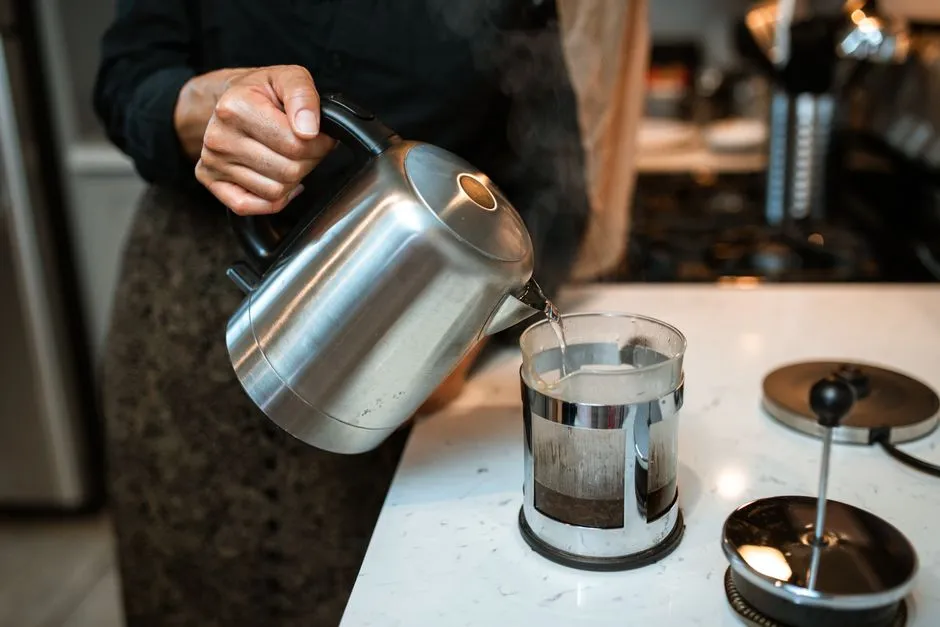
Start timing as soon as water begins touching the grounds. Pour steadily enough that the full bed becomes wet without turning the process into a long, staged pour. Put the lid on with the plunger raised once the coffee is saturated.
Choose one repeatable way to handle the floating crust. Some recipes use an early stir, while others disturb the grounds later. Alternating between methods makes a timing test hard to read.
For a simple home routine, use the same pour and stir pattern every time. Then the timer is measuring a real change rather than hiding several changes inside one brew.
What happens with a shorter steep?
A shorter steep gives water less time to dissolve material from the coffee. It may produce a cup that seems thinner, sharper or less developed, especially with a coarse grind. Those words are observations, not a diagnosis: water temperature, dose, roast and grind can create similar impressions.
Coffee extraction is fastest early and then slows. A peer-reviewed kinetics study of coffee extraction found an initial fast stage followed by a much slower stage across the temperatures and particle sizes it tested. Cutting a four-minute recipe substantially short therefore removes part of the brew while extraction is still progressing.
If a cup tastes weak at three minutes, first confirm that the ratio and water temperature did not change. Then repeat the same recipe at four minutes. Do not simultaneously add more coffee and grind finer, because you will not know which change helped.
What happens with a longer steep?
Extraction continues after four minutes, but it does not continue at the same speed as it did at the beginning. The same kinetics research shows why an extra minute is not equivalent to doubling the first minute. A longer steep may give a fuller or more developed cup, or it may make an unwanted dry or bitter quality easier to notice. The result depends on the coffee and the rest of the recipe.
Do not assume that a five- or six-minute press is automatically ruined. Press it, decant it and taste it. If you prefer it, you have learned something useful about that coffee. If it is harsher than the four-minute version, return to four minutes before changing another variable.
A full-immersion brewing study also found that immersion behaves differently from a simple picture in which extraction climbs at a constant rate forever. That is another reason to use taste and controlled comparisons instead of treating one missed timer as a disaster.
How does grind size change the timing?
Smaller coffee particles expose more material to water and change the pace of extraction. The kinetics study found that decreasing particle size increased the final extraction yield under its test conditions. A finer grind can therefore move a recipe along faster, while a coarser grind generally needs more contact time to reach a similar point.
That does not mean you should use a very fine grind and a very short steep in a conventional French press. Fine particles can pass through the mesh and make the cup silty, and they can make the plunger harder to lower. Start medium-coarse to coarse, use four minutes, and treat time as a fine adjustment after the grind is in the right neighborhood.
When you change beans or move the grinder, return to the four-minute baseline. Otherwise, an old timing correction can follow you into a new setup where it no longer belongs.
How should you adjust a French press steep?
Keep a note of the grind, ratio, water temperature and time. Then adjust only one item for the next brew.
| What you notice | First check | One controlled next test |
|---|---|---|
| Thin or less developed | Ratio and water temperature were unchanged | Extend four minutes by 30 seconds |
| Dry or unpleasantly bitter | Coffee was not left in the press after plunging | Shorten four minutes by 30 seconds |
| Heavy sediment | Grind is too fine or uneven | Grind coarser; keep four minutes |
| Plunger is hard to lower | Grind is too fine, or the filter is obstructed | Stop forcing it, correct the grind and retry |
| Good flavor but too strong | Coffee-to-water ratio | Adjust the ratio, not the steep |
Our coffee-to-water ratio guide separates strength from extraction. That distinction matters: more coffee can make a drink stronger without solving a timing problem.
Why should you pour the coffee out after plunging?
In a conventional French press, lowering the mesh moves most grounds below the filter but does not remove the brewed liquid from them. Contact continues, even as extraction slows. Both Bodum and ESPRO end their published methods by pouring the coffee after the press.
Decant every serving immediately. If you are not drinking it all at once, use a clean preheated server or insulated carafe rather than leaving the second cup in the press. A brewer with a valve or sealed filter may behave differently, so follow that model's manual rather than assuming every plunger stops contact in the same way.
What is the easiest repeatable routine?
- Measure the same coffee and water as your last brew.
- Use the same grind setting and water-temperature routine.
- Start the timer when the pour begins.
- Wet all the grounds and repeat the same stir pattern.
- Put the lid on with the plunger raised.
- At four minutes, lower the plunger slowly without forcing it.
- Pour all the coffee immediately.
- Taste before deciding what to change next time.
Four minutes, then pour. That routine is simple enough to repeat and precise enough to improve. Once it is stable, a 30-second timing change tells you something. Before it is stable, the timer is just one moving part among several.